04 / PixelLab service
Platforms & commerce
Designed like an editorial system. Engineered like production infrastructure.
Custom web application and e-commerce development for businesses whose requirements no longer fit an off-the-shelf plugin. Pixellab designs backend logic, integrations, customer experience, and internal tools as one maintainable system.
Because these systems tend to grow well beyond their first release, code is organised so new payment methods, roles, or integrations can be added without reworking what already works. Where a project involves money, personal data, or contractual commitments, that structure is treated as a requirement rather than a nice-to-have.
Timeline
8–16 weeks
Stack bias
Laravel / Filament / Stripe
Next step
Technical discovery call
What this service solves
Complex platforms are shaped by rules: who can access data, how payments and refunds behave, what staff can manage, and how external systems stay in sync. Those rules are translated into a clear domain model and dependable workflows before adding interface complexity.
Projects are built around security, observability, and long-term ownership. Automated tests protect critical journeys, queues handle expensive work, and dashboards give teams control without requiring developer support for everyday operations.
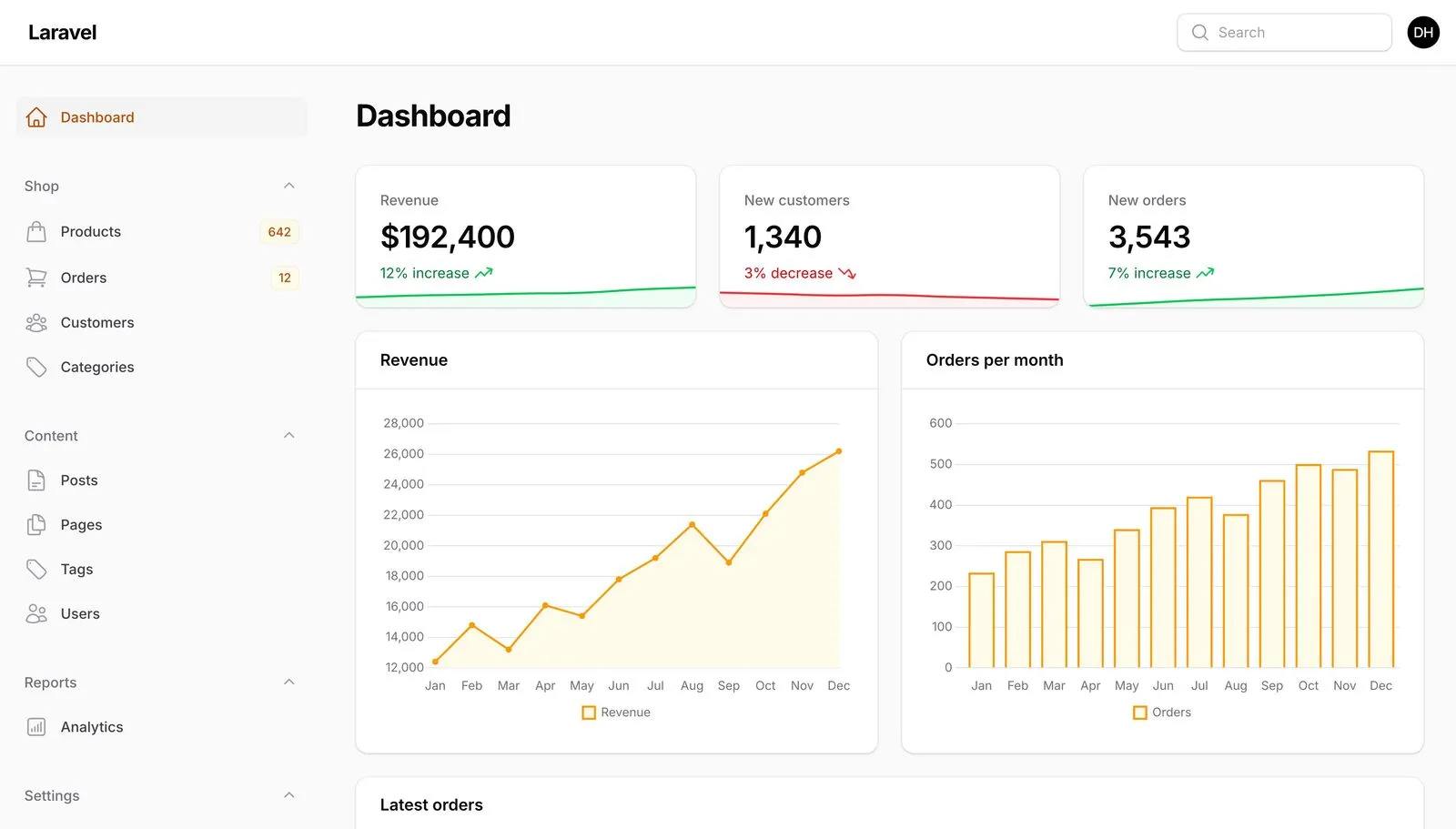
Custom admin panel
Built with Filament for Laravel
Every platform ships with a custom admin panel shaped around how your team actually works: orders, catalogue, content, roles, and exceptions in one calm interface. Built with Filament on LaravelA PHP backend framework used to build secure business logic, APIs, and admin systems., it gives your team direct control of daily operations without waiting on a developer.
The admin area is designed as the operational heart of the platform, not an afterthought. Workflows are mapped around real tasks so updates, approvals, and edge cases are handled with less friction.
Tables, forms, dashboards, and permissions are tailored to your domain — not a generic CMS.
What is included
Product and backend architecture
Domain model, business rules, permissions, and data flows designed so the platform can grow without rewriting the core.
Responsive customer-facing application
Storefronts, memberships, bookings, or account experiences built around the journeys that generate revenue and retention.
Admin dashboard and permissions
Custom Filament admin panels so staff can manage orders, users, content, and exceptions without needing developer support for everyday work.
Stripe payments and subscriptions
Checkout, billing, refunds, and subscription logic implemented with provider-hosted payment collection where possible.
Third-party API integrations
Reliable sync with CRMs, fulfilment, inventory, marketing, or other systems that keep operations moving.
Testing, monitoring, and deployment
Automated coverage around high-risk journeys, plus observability and release process prepared before go-live.
How the project works
- 01
Workflow discovery
Users, business rules, data, exceptions, integrations, and the operational tasks the platform must support are mapped first.
- 02
Technical design
The domain model, API boundaries, permissions, infrastructure, and an incremental delivery plan are defined.
- 03
Iterative development
Core journeys are built and reviewed in stages, with automated tests around payments, permissions, and other high-risk logic.
- 04
Launch and support
Data, monitoring, deployment, documentation, and team handover are prepared before the platform goes live.
Frequently asked questions
Can you build a custom e-commerce website?+
Yes. Pixellab builds tailored storefronts and commerce workflows when standard themes or plugins cannot support the required pricing, checkout, subscription, fulfilment, or integration logic.
Do you work with existing Laravel or Node applications?+
Yes. Existing codebases can be audited, with feature development, performance improvements, architecture modernisation, and reliability fixes handled as needed. The first step is a technical review to identify constraints and risks.
Which payment systems can you integrate?+
Stripe is the usual choice for card payments, subscriptions, and marketplace flows, but other providers can be integrated where the business or market requires them.
How do you protect customer and payment data?+
The implementation follows least-privilege access, secure authentication, input validation, dependency maintenance, audit logging, and provider-hosted payment collection where possible. Exact controls depend on the platform and compliance needs.
Related work
Have a project in mind?
Work directly with a developer.
Share your goals, current challenges, and preferred timeline. You will receive a practical first response within one business day.